
CALL NOW!
Read Our Latest Posts
Lorem ipsum dolor sit amet, consectetur adipiscing elit. Duis imperdiet nisi ac augue elementum porttitor.
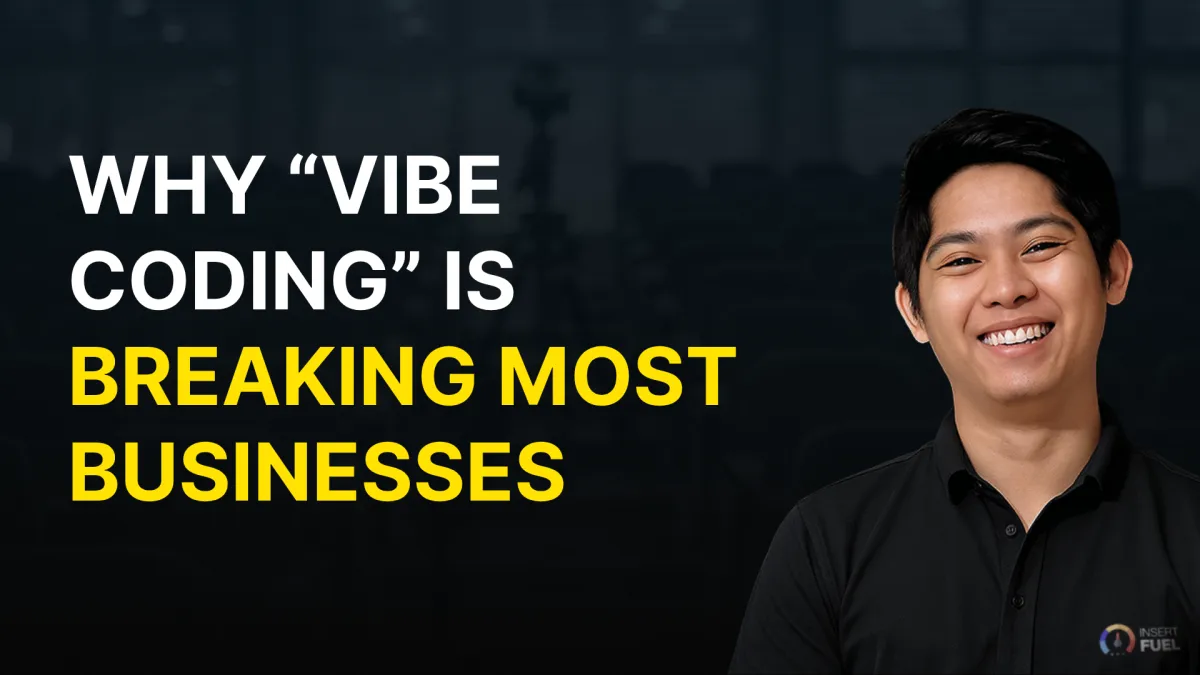
Why Vibe Coding Fails Businesses: Effective Solutions
Why “Vibe Coding” Is Breaking Most Businesses (And What Actually Works)
Vibe coding is the latest shiny promise: type a loose idea into an AI, watch it “build” your funnel, your app, or your automations, and skip all the boring planning. For a lot of individuals and small businesses, it sounds like magic. In practice, it’s often a slow, buggy mess that quietly burns time and money.
The Hype: “Just Prompt It and You’re Done”
Scroll social media and you’ll see the same pitch on repeat: “You don’t need to understand tech—just vibe code it.” Influencers demo AI tools that spin up landing pages, email flows, and CRM automations from a single prompt. It looks effortless and instant.
The problem is what you don’t see: the crashes, the half-working flows, and the hours of manual cleanup. Most people are sold the fantasy that AI replaces thinking. In reality, when you skip the thinking, AI simply amplifies the chaos you already have.
What Vibe Coding Actually Is (When Done Right)
At its best, vibe coding isn’t blind prompting—it’s AI-assisted building. You still design the system; the AI just helps you move faster. Think of it like working with a very fast junior assistant, not a magical co-founder who reads your mind.
Real vibe coding means you: decide the structure, rules, and steps, then use AI to draft components, generate variations, and wire pieces together. The “vibe” should guide creativity and tone, not replace architecture and logic.
Why You’re Getting Slow, Buggy Outputs
Most of the pain people feel with vibe coding comes from two issues: giant, unstructured prompts and no clear system design.
You paste a wall of text: brand story, offer, funnel idea, email tone, and tech stack into one prompt and say, “Build it all.”
The AI tries to do everything at once—copy, logic, integrations—and ends up doing nothing well. Outputs are slow, inconsistent, and full of small but deadly errors.
Large, messy prompts force the model to guess what matters. Without structure, it guesses wrong, and you pay for that confusion in debugging time and broken customer journeys.

Overstuffed, unstructured prompts create tangled workflows that look impressive but fail under real traffic.
A Real-World Example: GHL AI Studio & Vibe Coder Limits
Tools like GoHighLevel’s AI Studio and Vibe Coder promise “describe it and we’ll build it.” They’re powerful, but they’re not mind readers. When users dump a vague paragraph like “Set up a full lead gen funnel with nurturing, booking, and follow-up,” the AI does what it can—but it has to invent missing details.
The result? Flows that don’t match your actual offer, emails that repeat themselves, conditions that never trigger, and logic that collapses the moment a real human does something unexpected. The limitation isn’t that GHL’s AI is “bad”; it’s that most people treat it like a genie instead of a power tool.
The Correct Approach: Modular Prompting, Systems Thinking, Iteration
To make vibe coding work, you need to think like a systems designer and build in modules:
Modular prompting: Break the build into pieces—offer description, lead capture, nurture, booking, follow-up. Prompt the AI for each module separately and refine before connecting them.
Systems thinking: Map the journey first. Who enters? What paths can they take? Where can they drop off? Use AI to fill in content and conditions, not to invent the map.
Iteration: Treat the first output as draft zero. Test with a few real leads, watch what breaks, and then prompt the AI to fix specific issues—one at a time.
Turning Vibe Coding into a Real Production Workflow
If you want vibe coding that survives real customers and real revenue, you need a grown-up process:
Define the outcome: One clear business goal per build—book calls, sell a product, onboard clients.
Sketch the system: Simple boxes and arrows are enough. Identify every step and decision point.
Use AI as a component builder: Ask it for specific assets—emails, conditions, tags, messages—module by module.
Test in sandboxes: Run through the flow yourself, then with a small group, before sending real traffic.
Continuously refine: Use data—open rates, drop-off points, support tickets—to drive the next round of prompts.
You don’t have to abandon vibe coding; you just have to stop treating it like a shortcut around thinking. The businesses that win with AI will be the ones willing to be the adult in the room—setting structure, enforcing clarity, and letting the “vibe” enhance a solid system instead of replace it.

What Our Clients Say
Check out our latest reviews

Person 1

This is a satisfied customer talking about how amazing you are to increase the confidence of your next buyer.
Person 2
Here is a different angle perspective from another customer showing how you delivered with confidence.
Person 3
Here is a different demographic that is talking about how you went above and beyond and delivered personal service.
Person 4
Lastly, here is yet another angle to show clients a mixed view of how you are perceived and why you should be trusted.